The career U-curve - from blissful ignorance to productive doubt…
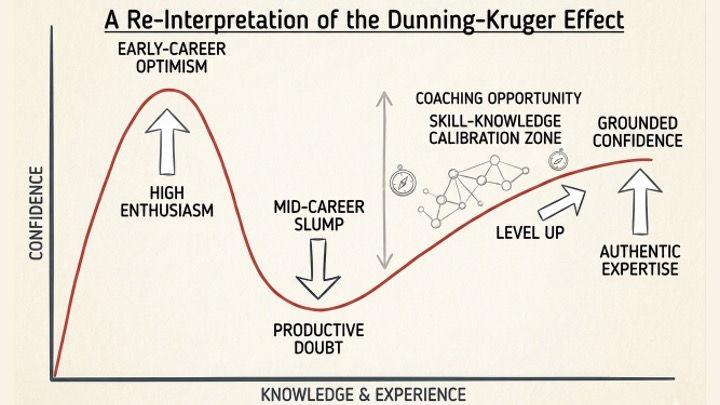
Self-belief is a topic that surfaces most in my coaching conversations. It may not always be framed directly as such, but it’s there - shackling otherwise brilliant, capable people from acknowledging their own knowledge, skills and value.
It is easy enough to spot because I’ve experienced those exact feelings myself. Most professional careers pass through three distinct psychological phases, and those familiar with the Dunning-Kruger effect will immediately recognise the pattern.
Phase 1: The Blissful Novice. This is the early stage of a career, driven by high enthusiasm. Novices don’t know what they don’t know, which acts as an effective shield against self-doubt. They take risks because they simply haven't seen things go spectacularly wrong yet.
Phase 3: The Liberated Veteran. Skipping ahead to the latter stages of a career, you find the leaders who have survived enough crises to know that nobody has all the answers. Their need for external validation drops, replaced by a grounded, "I'm here for a reason" self-assurance.
Phase 2: The Socratic Valley. This is the messy middle where mid-career leaders live. As you step into technical and commercial management, complexity scales exponentially. You realise how much you actually don't know. The stakes are higher, the variables are less obvious and the data is never complete.
Let's be clear though this isn't simply ‘imposter syndrome’. It is a rational response to complexity.
Research into the Dunning-Kruger effect shows that while unskilled people routinely overestimate their abilities, highly skilled individuals tend to underestimate theirs.
Because they have a high level of domain expertise, they are acutely aware of the vastness of the field. If you are doubting yourself right now, it is not because you’re inadequate it’s because your awareness of the problem's complexity has temporarily outpaced your immediate solution.
Furthermore, research into intellectual humility - the recognition that your beliefs or knowledge might be incomplete - shows that leaders who possess it are actually better at processing complex information, more receptive to feedback and make more accurate decisions. Your mid-career self-doubt isn't a crisis, it is the birth of intellectual humility. It makes you a more rigorous problem solver than someone armed with unearned overconfidence.
Studies have even shown that leaders who experience these ‘imposter thoughts’ tend to have stronger interpersonal skills. Because they question their own assumptions, they focus more on reading others, bridging communication gaps and calibrating their approach. Their self-doubt actually makes them more empathetic and communicative - critical commercial skills that technical leaders often lack early on.
Ultimately, this phase of doubt isn't a psychological defect. It is a necessary evolutionary step. It is the moment a leader transitions from being a subject matter expert where they control the variables to a commercial and people leader where they control just about nothing completely.
Normalising this transition and helping leaders navigate it is a core part of what a good coach does. When you are in the thick of Phase 2, it is incredibly difficult to see your own bandwidth objectively. A coach helps you calibrate your self-assessment against real-world data points, separating valid strategic caution from paralysing self-criticism. Together, we reframe your doubt not as a stop sign, but as a compass turning that internal friction into the very insight that will eventually carry you into Phase 3.



Comments